
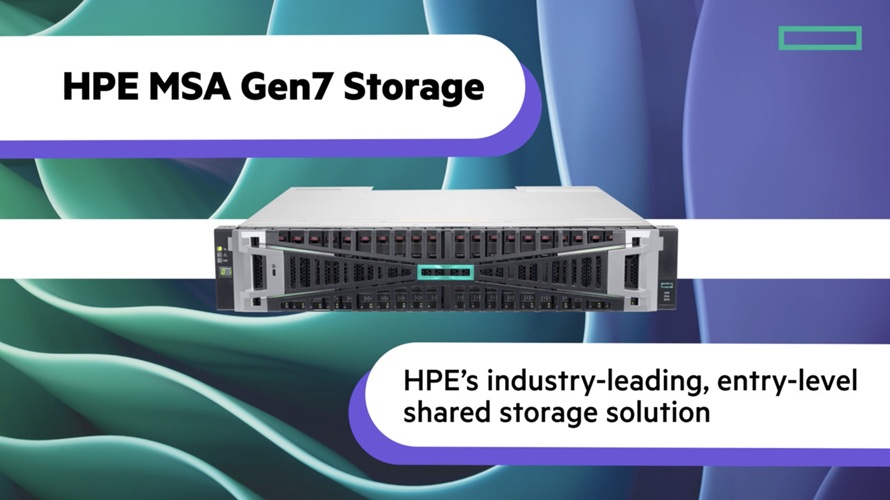
The HPE MSA Gen7 Storage family is designed to give small and midsize businesses, virtualization environments, and enterprise workloads access to fast, scalable, and relatively simple shared storage without the complexity and cost often associated with larger enterprise storage platforms.
As the next generation of HPE’s MSA platform, Gen7 focuses on three important areas: performance, scalability, and simplified management. HPE states that MSA Gen7 can deliver up to twice the system performance of the previous MSA Gen6 generation while supporting more than 7 PB of raw capacity in suitable configurations.
This review looks at the HPE MSA Gen7 architecture, performance, storage options, connectivity, data protection, management features, scalability, and overall enterprise value.
What Is HPE MSA Gen7 Storage?
HPE MSA Gen7 is a block-storage platform designed primarily for shared storage environments. It is available in different configurations, including models supporting Fibre Channel, iSCSI, and 12Gb SAS connectivity.
The platform uses a 2U rack-mounted design with either Small Form Factor (SFF) or Large Form Factor (LFF) drive configurations. Each array uses two storage controllers, with four host ports per controller, providing up to eight host ports per array depending on the selected model.
One of the models in the Gen7 family is the HPE MSA 2072 16Gb Fibre Channel SFF Storage, which is specifically covered by the HPE data sheet referenced for this review.
This makes the MSA Gen7 platform particularly interesting for organizations that need shared storage for virtualization, databases, file services, application servers, and other business workloads.
HPE MSA Gen7 Performance
Performance is one of the biggest improvements in the Gen7 generation.
According to HPE’s published benchmark results, MSA Gen7 reaches up to:
- 783,000 random read IOPS
- 227,000 random write IOPS
- 14.1 GB/s segmented sequential read throughput
- 9.6 GB/s segmented sequential write throughput
These figures are HPE benchmark results rather than guaranteed performance for every installation. Actual performance depends on the number and type of drives, workload characteristics, RAID configuration, host systems, operating systems, and the number of connected hosts.
For businesses running virtual machines, databases, transactional applications, or other I/O-intensive workloads, these numbers demonstrate that MSA Gen7 is capable of providing significantly more performance than a conventional entry-level storage system.
HPE also positions Gen7 as offering up to 2x the random IOPS and approximately 30% higher sequential bandwidth compared with MSA Gen6, making the generational upgrade particularly relevant for organizations that are replacing older MSA infrastructure.
HPE MSA Gen7 Storage Architecture
MSA Gen7 uses a dual-controller architecture. The controllers operate in an active/active configuration and provide redundancy for business-critical environments.
Each array provides:
- Two storage controllers
- Four host ports per controller
- Up to eight host ports per array
- 48 GB of system cache
- 12Gb SAS expansion connectivity
- Battery-free cache protection using supercapacitors and non-volatile memory
- Support for SFF and LFF storage configurations
The dual-controller architecture is important because it reduces the risk associated with a single controller failure and provides a more resilient storage platform for production environments.
Fibre Channel, iSCSI, and SAS Connectivity
One of the strengths of the MSA Gen7 platform is its flexibility in host connectivity.
Depending on the model, organizations can select:
- 16Gb Fibre Channel
- 32Gb Fibre Channel on supported models
- 10/25GbE iSCSI
- 10GBASE-T iSCSI
- 12Gb SAS
The MSA 2072 16Gb Fibre Channel SFF configuration is especially relevant to businesses that already have a Fibre Channel SAN infrastructure and want to integrate a new storage array without replacing their existing SAN architecture.
For organizations building a new storage environment, 10/25GbE iSCSI can also provide a practical alternative because it can use Ethernet networking infrastructure rather than requiring a dedicated Fibre Channel fabric.
Storage Capacity and Scalability
Scalability is another major advantage of HPE MSA Gen7.
Depending on the configuration, a base array can support up to 24 SFF drives or 12 LFF drives. The platform can also connect up to nine additional drive enclosures.
With supported SFF configurations, HPE specifies up to 7.37 PB of raw capacity per array. LFF configurations can scale to approximately 2.88 PB of raw capacity.
This gives organizations the ability to start with a relatively small storage deployment and add capacity as requirements increase.
The available drive options include SSDs, enterprise SAS HDDs, and high-capacity Midline SAS HDDs. This allows administrators to balance performance, capacity, and cost depending on the workload.
HPE MSA-DP+ RAID Technology
Data protection is a critical consideration in any enterprise storage system.
HPE MSA Gen7 supports several RAID options, including:
- RAID 1
- RAID 5
- RAID 6
- RAID 10
- MSA-DP+
RAID 0 is supported for read-cache use rather than general data protection.
One of the more interesting technologies is MSA-DP+, HPE’s advanced data protection technology. Instead of relying exclusively on traditional dedicated spare drives, MSA-DP+ distributes spare capacity across the disks in a disk group.
HPE states that MSA-DP+ can provide rebuild times up to 25 times faster than traditional RAID under appropriate conditions.
For large-capacity disks, faster rebuilds can be particularly valuable because traditional RAID rebuild operations can take a significant amount of time.
Automated Storage Tiering
Organizations with mixed workloads can also take advantage of MSA Gen7’s automated tiering capabilities.
The platform supports three main storage tiers:
- Performance Tier – SSD storage for frequently accessed data
- Standard Tier – Enterprise SAS HDD storage
- Archive Tier – Midline SAS HDD storage
The automated tiering system can move frequently accessed data toward faster storage while less active data can remain on more economical capacity-oriented drives.
This approach can help businesses achieve a better balance between performance and storage cost without requiring administrators to manually move data between different storage classes.
However, organizations should carefully review licensing requirements because some mixed SSD/HDD configurations and advanced tiering functions require the HPE MSA Advanced Data Services Suite.
Snapshots and Data Protection
MSA Gen7 also includes snapshot functionality for point-in-time data protection.
The platform provides standard snapshot functionality, while configurations such as the MSA 2072 include the Advanced Data Services Suite with additional capabilities.
With the appropriate licensing, the platform can support up to 512 snapshots, as well as volume copy and remote snapshot functionality.
Snapshots can be useful for:
- Application recovery
- Backup workflows
- Testing
- Development environments
- Protection against accidental data changes
- Rapid recovery from certain operational problems
For organizations that need replication between storage systems, Remote Snap can provide array-based asynchronous replication when the required licensing is available.
Management and Monitoring
Storage management is often one of the most important factors when comparing enterprise storage products.
HPE MSA Gen7 uses the MSA Storage Management Utility (SMU) v4, a web-based management interface designed to simplify configuration and ongoing administration.
The platform also supports:
- RESTful management interfaces
- Redfish and Swordfish
- Command Line Interface (CLI)
- HPE MSA Health Check
- Firmware update notifications
- Online controller and drive-media firmware updates
One particularly useful improvement in Gen7 is the ability to perform supported controller and media firmware updates online without disrupting normal operations, when the required multipathing configuration is in place.
For IT teams with limited storage-administration resources, these management improvements can reduce the operational burden of maintaining the array.
HPE MSA Health Check
HPE MSA Health Check is another useful component of the Gen7 ecosystem.
The service analyzes MSA system information and checks the configuration and performance environment against HPE best practices. HPE describes the service as a cloud-based tool available to MSA users without an additional charge.
This can be useful for organizations that do not have a dedicated storage specialist monitoring the array every day.
Instead of waiting for a serious storage problem to occur, administrators can use health-check information to identify configuration or performance issues that may require attention.
HPE MSA Gen7 for Virtualization
Virtualization is one of the most natural use cases for MSA Gen7.
The platform supports environments including VMware vSphere, Microsoft Windows Server, Red Hat Linux, and SUSE SLES, subject to the applicable compatibility requirements.
For virtualization environments, storage performance and latency can directly affect the performance of multiple virtual machines.
An MSA Gen7 configuration using SSDs and an appropriate Fibre Channel or high-speed iSCSI architecture can therefore provide a strong storage foundation for:
- Virtual machine clusters
- Business applications
- Database servers
- ERP systems
- Development environments
- Backup infrastructure
The correct drive configuration is still essential. A storage array with impressive controller specifications cannot compensate for an improperly designed disk configuration or an overloaded network.
HPE MSA Gen7 Reliability
Reliability is another important aspect of the MSA Gen7 design.
The platform uses redundant controllers and supports multiple RAID levels. It also provides redundant power options and is designed for enterprise rack environments.
HPE also supports customer self-installation, self-repair, and self-upgrade capabilities for the platform, although organizations should always follow HPE’s supported procedures and service requirements.
The combination of redundant components, RAID protection, snapshots, and optional replication makes MSA Gen7 considerably more capable than basic direct-attached storage.
HPE MSA Gen7 Energy Efficiency
Power consumption is becoming increasingly important for data centers and server rooms.
MSA Gen7 systems use power supplies designed around high efficiency, with HPE specifying 94% efficient power supplies for the platform and 80 PLUS Platinum-rated 2U 580W power supplies in the technical specifications.
Actual energy consumption will vary based on the selected configuration, number of drives, workload, and environmental conditions.
HPE MSA Gen7 Enterprise Value
The main selling point of MSA Gen7 is not simply raw performance. Its value comes from the combination of performance, scalability, flexibility, and relatively straightforward administration.
For smaller enterprises and midsize businesses, purchasing a much larger enterprise storage platform can introduce unnecessary complexity and expense.
MSA Gen7 offers a different approach: organizations can start with a smaller configuration and expand storage capacity as their requirements grow.
HPE also provides different combinations of SSD, enterprise SAS HDD, and Midline SAS HDD storage, allowing businesses to choose a configuration that matches their performance and capacity requirements.
HPE MSA Gen7 Pros and Cons
Pros
- Strong performance for an entry-level shared-storage platform
- Up to 783,000 random read IOPS in HPE’s published benchmark
- Up to 14.1 GB/s segmented sequential read performance
- Dual-controller architecture
- Support for Fibre Channel, iSCSI, and SAS depending on model
- SSD, enterprise SAS HDD, and Midline SAS HDD options
- Scalability beyond 7 PB in supported SFF configurations
- MSA-DP+ data protection
- Automated storage tiering
- Snapshot and replication capabilities
- Online firmware update capabilities
- HPE MSA Health Check
- Suitable for virtualization and general enterprise workloads
Cons
- Some advanced features require additional licensing
- Actual performance can vary considerably depending on the configuration
- High-capacity configurations can become expensive as SSDs and expansion enclosures are added
- Organizations unfamiliar with SAN architecture may need additional expertise for Fibre Channel deployments
- It is primarily a block-storage platform rather than an all-in-one NAS solution
HPE MSA Gen7 vs. MSA Gen6
For organizations already running MSA Gen6, upgrading to Gen7 can make sense when higher performance, additional scalability, and improved management capabilities are required.
HPE positions Gen7 as delivering up to 2x the random IOPS and 30% more sequential bandwidth compared with the previous generation. Gen7 also adds improvements such as expanded high-capacity media support, online firmware updates, and easier access to MSA Health Check.
The decision to upgrade should nevertheless be based on actual workload requirements rather than specifications alone. If an existing Gen6 system is not experiencing performance, capacity, or support limitations, an immediate replacement may not always be necessary.
Is HPE MSA Gen7 Worth It?
For businesses looking for a scalable shared storage platform with enterprise-oriented features without moving into a much more complex storage architecture, HPE MSA Gen7 is a compelling option.
Its strongest advantages are the combination of high performance, flexible connectivity, dual-controller redundancy, large expansion capacity, SSD support, automated tiering, snapshots, and straightforward management.
The HPE MSA 2072 16Gb Fibre Channel SFF configuration is particularly interesting for organizations that already operate a Fibre Channel SAN and need a high-performance shared-storage platform.
However, buyers should look beyond the base array price. Advanced data services, additional drives, expansion enclosures, Fibre Channel infrastructure, support contracts, and licensing can significantly affect the total cost of ownership.
Final Verdict
The HPE MSA Gen7 Storage is a strong choice for SMBs, midsize enterprises, virtualization environments, and organizations that need dependable shared block storage with room to grow.
Its combination of up to 783,000 random read IOPS, 14.1 GB/s sequential read performance, dual controllers, multiple connectivity options, advanced RAID protection, automated tiering, and scalability up to 7.37 PB in supported configurations makes it substantially more capable than a basic entry-level storage system.
The biggest advantage of MSA Gen7 is its balance. It provides many of the capabilities businesses expect from enterprise storage while maintaining a relatively straightforward architecture.
For organizations upgrading from older MSA generations or moving from basic direct-attached storage toward a shared SAN environment, HPE MSA Gen7 deserves serious consideration.
Frequently Asked Questions
What is HPE MSA Gen7?
HPE MSA Gen7 is a shared block-storage platform designed for SMB and enterprise workloads, supporting configurations based on SSDs, SAS HDDs, Fibre Channel, iSCSI, and SAS connectivity.
How much storage can HPE MSA Gen7 support?
Depending on the configuration, HPE specifies up to 7.37 PB of raw SFF capacity or up to 2.88 PB of raw LFF capacity per array.
How fast is HPE MSA Gen7?
HPE’s published benchmark results list up to 783,000 random read IOPS, 227,000 random write IOPS, 14.1 GB/s segmented sequential reads, and 9.6 GB/s segmented sequential writes. Actual performance depends on configuration and workload.
Does HPE MSA Gen7 support Fibre Channel?
Yes. Depending on the model, MSA Gen7 supports 16Gb and 32Gb Fibre Channel connectivity. The HPE MSA 2072 configuration referenced in the supplied HPE document uses 16Gb Fibre Channel connectivity.
Is HPE MSA Gen7 good for VMware?
Yes. HPE lists VMware vSphere among the supported operating-system environments for MSA Gen7, making the platform suitable for many virtualized workloads when properly configured.
Does MSA Gen7 support SSDs?
Yes. MSA Gen7 supports multiple SSD capacities as well as enterprise SAS and Midline SAS HDD options, allowing organizations to build all-flash, hybrid, or capacity-focused configurations.
What is MSA-DP+?
MSA-DP+ is HPE’s advanced data-protection technology for MSA storage. It distributes spare capacity across the disk group and is designed to provide faster rebuilds and efficient use of available capacity.